Arithmetic Intensity
The ratio of arithmetic operations to memory traffic in a kernel, usually measured in operations (FLOPs) per byte moved.
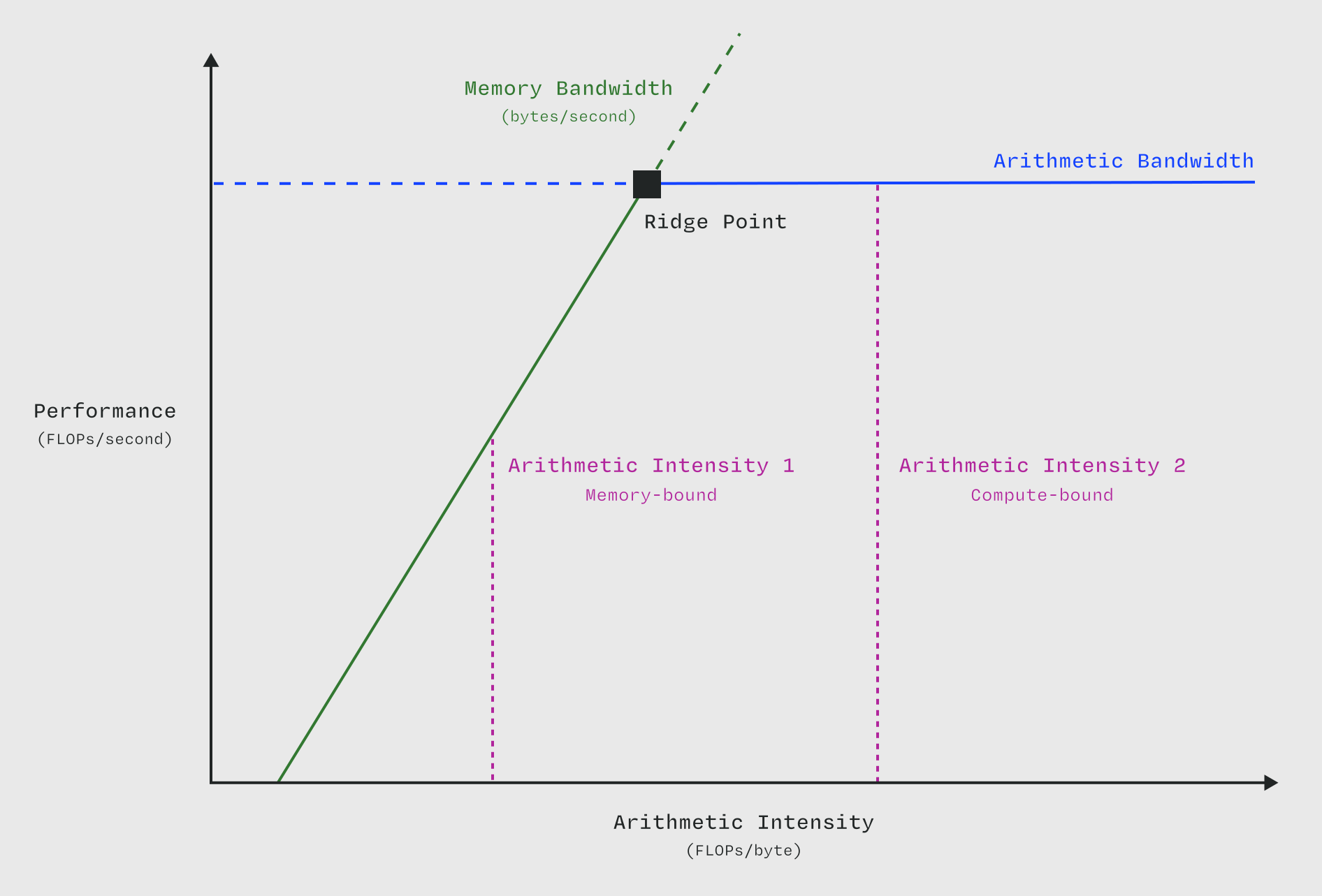
Arithmetic intensity is the ratio of arithmetic operations to memory operations in a kernel. A kernel with high arithmetic intensity performs many arithmetic operations per byte it loads.
Why it matters#
Modern GPUs have far more arithmetic bandwidth than memory bandwidth, so the most efficient kernels have high arithmetic intensity. When elevating a memory bottleneck, you can often shift work from the memory subsystem to the compute subsystem: less memory traffic, more load on the arithmetic units.
Two examples:
- Compression. Compressing data in global memory means fewer bytes to transfer, at the cost of extra decompression work on the compute units. If you were memory-bound, this can improve performance. It also raises FLOPs per byte moved, so arithmetic intensity goes up.
- Gradient checkpointing. The backpropagation algorithm creates long-lived intermediates (activations) that generally must be stored in global memory during the forward pass and read back during the backward pass. Sometimes it is faster to store only some of them and recompute the rest (gradient checkpointing), which increases arithmetic intensity.
How it scales with problem size#
Different algorithms have different operational and memory complexities, so their arithmetic intensity scales differently. An algorithm with O(1) operations and O(N) memory has O(1/N) arithmetic intensity scaling; one with O(N) operations and O(1) memory has O(N) scaling.
| Kernel | FLOPs | Bytes moved | Arithmetic intensity | Scaling |
|---|---|---|---|---|
| SAXPY y = ax + y | 2N | 12N | 1/6 | O(1) |
| Single-precision real FFT | 5/2 N log(N) | 16N | 5/32 log(N) | O(log(N)) |
| SGEMM C = A @ B + C | 2N³ | 16N² | N/8 | O(N) |
Key idea Matrix multiplication is O(N³) in operations and O(N²) in memory, so its arithmetic intensity grows linearly, O(N). That makes it easy to map onto arithmetic-intensity-oriented hardware, and is a key secret behind the success of matrix-multiplication-based machine learning, like neural networks, over the past few decades.
See the roofline model article for why hardware has evolved this way. For arithmetic intensity applied to Bahdanau attention as used in Transformers, see this paper by Zadouri, Strauss, and Dao.
Ridge points of recent GPUs#
The minimum arithmetic intensity needed to be compute-bound, i.e. past the roofline's ridge point, is a fixed property of a system, so it only needs to be derived once. The table lists ridge points for recent NVIDIA data center GPUs. The highest ridge point has risen from the Ampere to Hopper to Blackwell Streaming Multiprocessor architectures.
| System (compute / memory) | Arithmetic bandwidth (TFLOPs/s) | Memory bandwidth (TB/s) | Ridge point (FLOPs/byte) |
|---|---|---|---|
| A100 80GB SXM BF16 TC / HBM2e | 312 | 2 | 156 |
| H100 SXM BF16 TC / HBM3 | 989 | 3.35 | 295 |
| B200 BF16 TC / HBM3e | 2250 | 8 | 281 |
| H100 SXM FP8 TC / HBM3 | 1979 | 3.35 | 592 |
| B200 FP8 TC / HBM3e | 4500 | 8 | 562 |
| B200 FP4 TC / HBM3e | 9000 | 8 | 1125 |
Related#
- Roofline model: plots performance against arithmetic intensity
- Compute-bound and memory-bound: the regimes on either side of the ridge point
- Arithmetic bandwidth: the numerator of the ridge point