CUDA Programming Model
NVIDIA's model for writing massively parallel programs, built on a hierarchy of thread groups, a hierarchy of memories and barrier synchronization.
The CUDA programming model is a way of writing programs for massively parallel processors. Its abstractions are designed so that a program gets faster automatically when it runs on a GPU with more parallel hardware.
"CUDA" stands for Compute Unified Device Architecture, and the name covers three distinct things:
- a high-level device architecture,
- a parallel programming model for hardware with that design (the subject of this article),
- a software platform that extends high-level languages like C with that programming model.
The vision for CUDA is laid out in the Lindholm et al., 2008 white paper. It is highly recommended reading: it is the original source of many claims, diagrams and even turns of phrase in NVIDIA's documentation.
Three key abstractions#
Per the NVIDIA CUDA C++ Programming Guide, the model rests on three abstractions:
- Hierarchy of thread groups. Programs run in threads, but can refer to groups of threads in a nested hierarchy, from blocks up to grids.
- Hierarchy of memories. Each level of thread group has a memory resource for communication within the group. Accessing the lowest layer should be nearly as fast as executing an instruction.
- Barrier synchronization. Thread groups coordinate their execution with barriers.
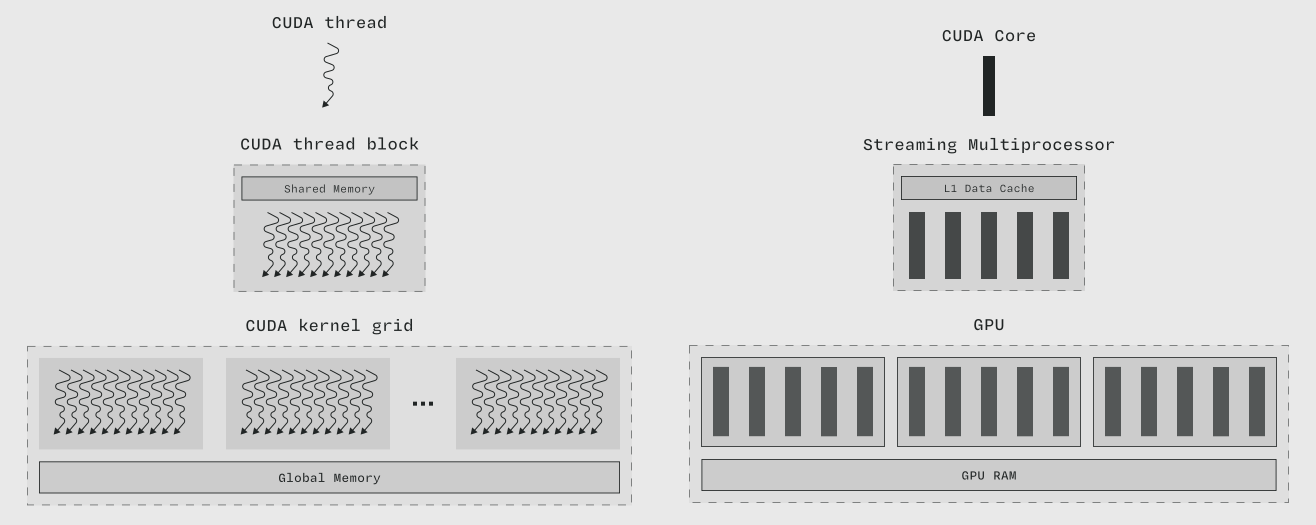
The diagram below shows the execution and memory hierarchies and how they map onto device hardware.
Why it scales#
Together, these abstractions push programmers to write code that scales transparently as GPUs gain more parallel execution resources. Put provocatively, the model stops you from writing programs for CUDA-architected GPUs that fail to get faster when the user buys a newer NVIDIA GPU.
Thread blocks are the clearest example. Threads within a block can coordinate tightly, but coordination between blocks is limited. So blocks capture independent, parallelizable pieces of the program and can be scheduled in any order. In computer-architecture terms, the programmer "exposes" this parallelism to the compiler and hardware. On a GPU with more scheduling units (specifically, more Streaming Multiprocessors), more blocks simply run at once.
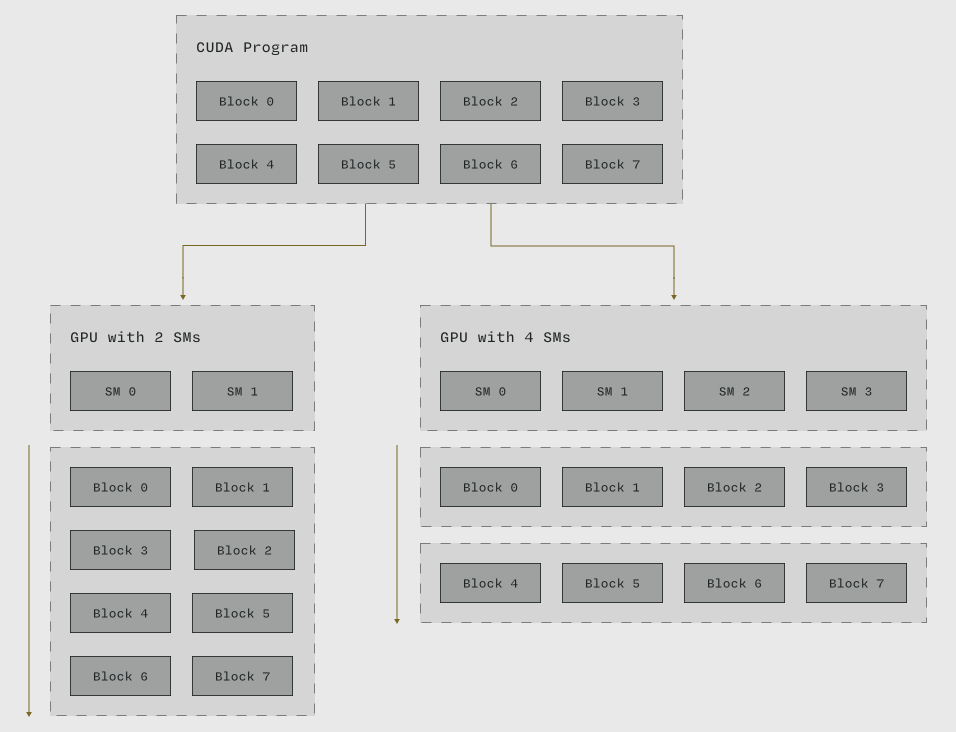
Key idea Because blocks must be independent, the same program fills a bigger GPU with more blocks at once, with no code changes.
How it is implemented#
Programmers reach the model through extensions to high-level CPU languages, such as the CUDA C++ extension of C++. Underneath, it is implemented by an instruction set architecture, Parallel Thread eXecution (PTX), and a low-level assembly language, Streaming Assembler (SASS). For example, the thread block level of the thread hierarchy is implemented in these languages as cooperative thread arrays.
Related#
- Thread Hierarchy: the execution side of the model
- Memory Hierarchy: the memory side of the model
- CUDA Tile Programming Model: a newer, tile-based alternative
- CUDA Device Architecture: the hardware design the model targets